


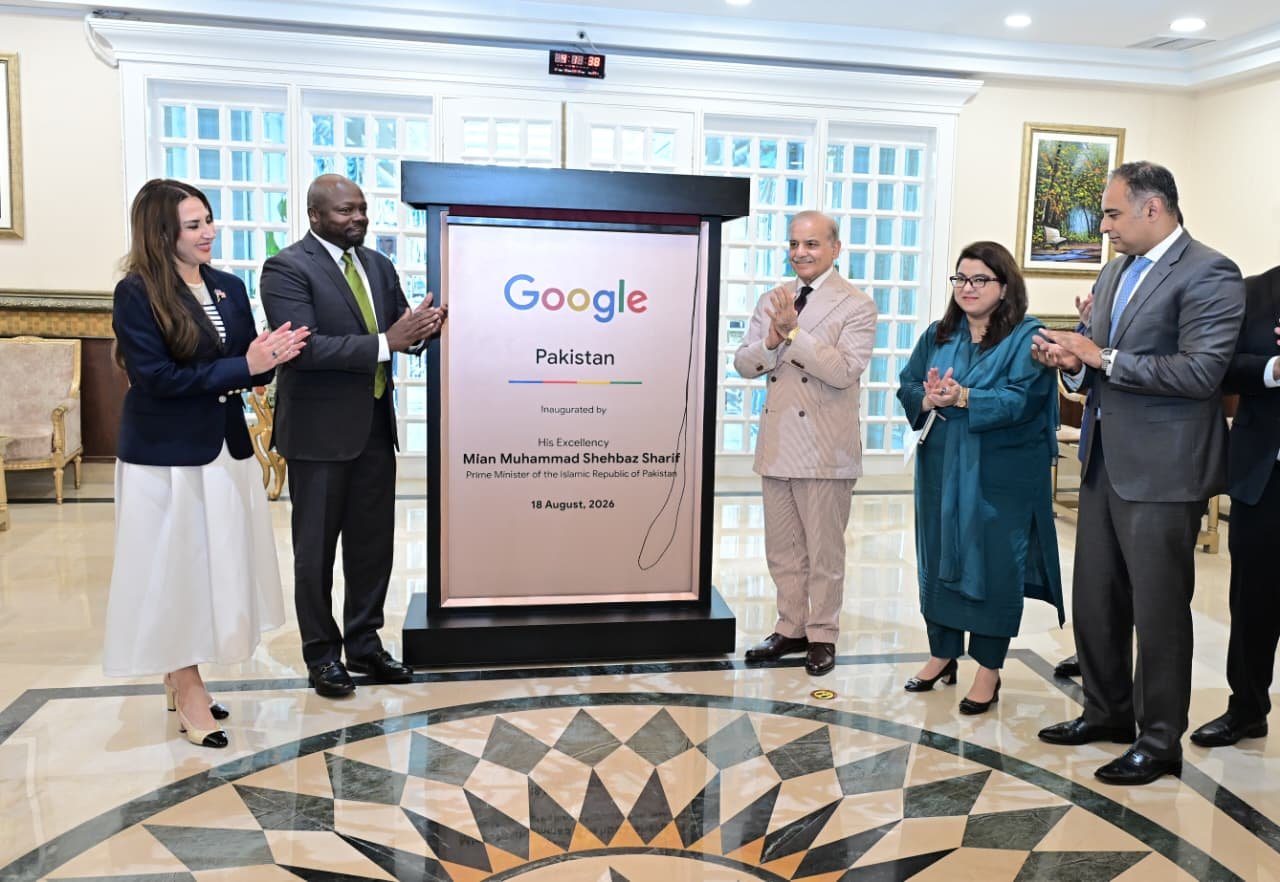
Islamabad — August 18, 2026
Google opens first Pakistan office, marking a significant new phase in the technology giant’s relationship with one of South Asia’s largest and youngest digital markets.
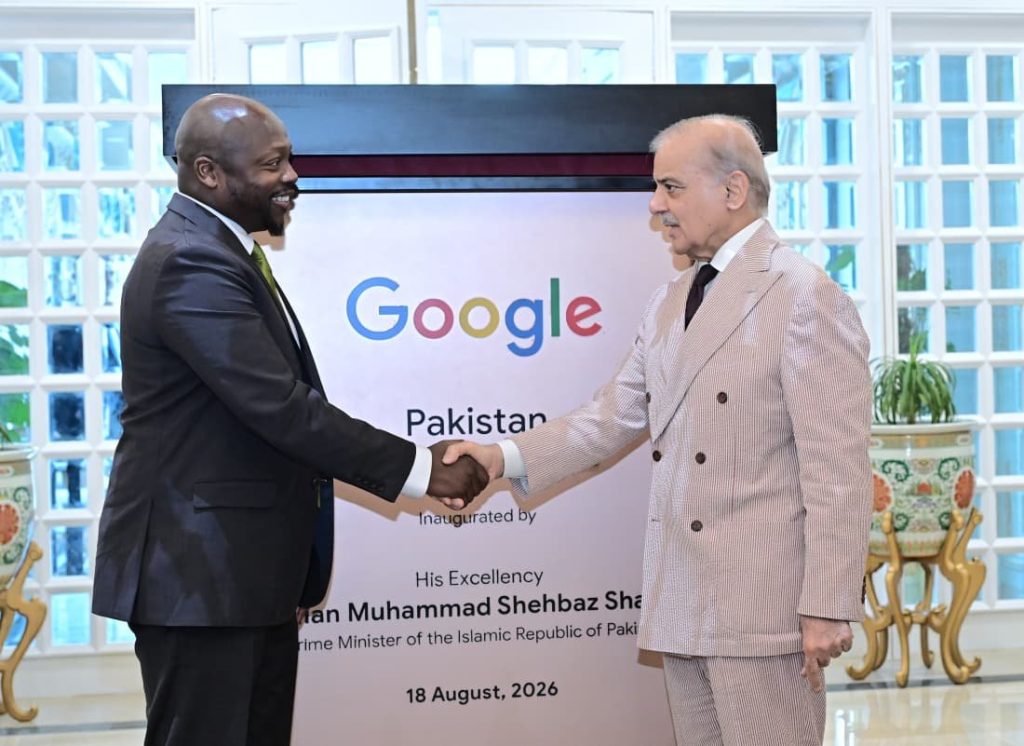
The Islamabad office, inaugurated on Tuesday in the presence of Prime Minister Shehbaz Sharif and senior Google officials, gives the company a formal on-the-ground presence in Pakistan at a time when the government is aggressively positioning information technology, artificial intelligence, digital services and technology exports as engines of economic growth.
Google Vice President for Government Affairs and Public Policy Wilson White, who led a nine-member Google delegation to Islamabad, said the company’s long-term commitment to Pakistan was closely aligned with the government’s ambition of turning the country into a $30 billion annual IT export hub.
“This is a very special moment,” White said at the inauguration, noting that Google has been investing in and working with Pakistan for more than a decade.
According to Google, its products and services have contributed more than Rs3.9 trillion in economic activity for Pakistani businesses and households over the past decade, while supporting more than 960,000 jobs.
White said Google’s next phase of engagement would focus on three broad areas: developing Pakistani talent, supporting hardware manufacturing and export infrastructure, and helping local businesses grow.
Islamabad : 18 August, 2026.
PM Shehbaz Sharif Meets Google Delegation to Discuss Digital Transformation; Inaugurates Google First Office in Pakistan to Boost Tech, Youth Upskilling.
A 9-member delegation of Google, led by Mr. Wilson White, Vice President for Government Affairs… pic.twitter.com/ztMadPpqdd
— Prime Minister’s Office (@PakPMO) August 18, 2026
For Pakistan, the significance of the office goes beyond having another multinational technology company physically present in Islamabad. It represents the formalisation of a relationship that has gradually expanded from digital products and developer communities into education, skills development, artificial intelligence, hardware manufacturing and now direct local operations.
From a Google presence to a Google office
Google’s relationship with Pakistan is considerably older than Tuesday’s inauguration.
The company’s first officially documented visit to Pakistan by a Googler dates back to 2008, when Google’s public policy team visited Karachi, Islamabad and Lahore and met government officials, technology organisations, media companies and business representatives. At the time, Google described the visit as an opportunity to better understand Pakistan’s rapidly developing internet market.
The company subsequently built its Pakistani presence largely through products, partnerships, local programmes and regional teams rather than a conventional corporate office.
That distinction became particularly important in the years immediately before the current expansion.
In March 2022, when speculation about a possible Google office was growing, Google’s regional leadership said there was no announcement regarding an office opening in Pakistan at that time. That position changed later in the same year.
Google registered in Pakistan in 2022
In November 2022, Google took a major step toward establishing a formal corporate footprint.
Google Asia Pacific Pte. Ltd. was registered with Pakistan’s Securities and Exchange Commission (SECP) on November 8, 2022, as a foreign company for the establishment of a liaison office in Pakistan.
At the time, the registration was described as preparation for the company to begin more structured operations in the country. Google also announced plans to provide thousands of scholarships to Pakistani citizens as part of its expanding engagement.
The move was significant because it transformed Google’s relationship with Pakistan from one primarily driven through regional operations and local partners into a formally registered presence inside the country.
But it still did not result in the full-scale local office that has now opened.
Skills became the first major pillar
While Google was not yet operating a full local office, its investment in Pakistan’s digital workforce continued to grow.
Through initiatives including Google Career Certificates, developer programmes and partnerships with organisations such as Tech Valley and the Pakistan Freelancers Association, Google increasingly focused on preparing Pakistan’s young population for digital employment.
The scale of those programmes expanded rapidly.
Tech Valley’s Google Career Certificates programme says it began with 15,000 scholarships in 2023, increased to 44,500 in 2024 and reached 100,000 in 2025. For 2026, the programme lists 150,000 scholarships across Pakistan.
That skills-first strategy is particularly relevant to Pakistan’s export ambitions because much of the country’s technology-export opportunity lies not in traditional manufacturing alone, but in software development, freelancing, cloud services, AI, digital marketing, business-process services and other knowledge-based exports.
2024: Google deepens its Pakistan engagement
The relationship gained further momentum in 2024.
A senior Google delegation met Pakistan’s Minister of State for IT and Telecommunication Shaza Fatima Khawaja in June that year to discuss education technology, artificial intelligence and the digital economy.
The government also highlighted Google’s work on local Chromebook assembly and digital literacy, while Google continued to expand skills and developer initiatives.
Later that year, Google’s economic impact research became another major talking point.
According to an Access Partnership report cited by Google, its AI-powered products and services generated Rs3.9 trillion in economic benefits for Pakistani businesses and households in 2023.
Google said its services—including Search, Ads, AdSense, Google Play, Google Cloud and YouTube, supported substantial business activity, while its broader ecosystem supported hundreds of thousands of jobs.
The figures helped reinforce Google’s argument that its impact in Pakistan already extended well beyond consumer search.
From software to hardware: Pakistan begins assembling Chromebooks
Perhaps the clearest indication that Google’s Pakistan strategy was evolving came in 2025.
In November 2025, Pakistan’s government and Google announced the country’s first Chromebook assembly line, developed with Google’s local partner Tech Valley and manufacturing partners including the National Radio and Telecommunication Corporation (NRTC).
The initiative was designed around a much larger target: 500,000 Chromebooks to be produced locally.
The government said the project could help establish local manufacturing and supply-chain capabilities while eventually creating opportunities for exports from Pakistan.
This was an important shift.
Google’s Pakistan engagement was no longer limited to training programmes, advertising, search, Android or cloud services. Hardware manufacturing introduced a physical production component to the relationship—and potentially connected Pakistan’s technology strategy with regional hardware supply chains.
The office decision was already underway in 2026
By April 2026, the government’s position was clear: Google had decided to establish an office in Pakistan.
During a meeting in Washington with Google’s Vice President and Global Head of Government Affairs and Public Policy Karan Bhatia, Finance Minister Muhammad Aurangzeb specifically welcomed Google’s decision to open an office in the country and linked it to the company’s existing work in AI, training, local Chromebook assembly and digital transformation.
The government said at the time that the office was expected to open in July 2026.
The planned local presence therefore represented the next step in a process that had already included corporate registration, education programmes, developer initiatives, AI engagement and local hardware production.
Google now aligns itself with Pakistan’s $30 billion IT ambition
The timing of the office opening is particularly important.
Pakistan has set an ambitious objective of expanding annual IT and IT-enabled services exports to $30 billion.
The target represents a dramatic increase from the country’s current export base, but the government has increasingly made technology a central part of its economic strategy.
In August 2025, Prime Minister Shehbaz Sharif directed officials to prepare a comprehensive roadmap with annual targets and measures to push IT exports beyond $30 billion in the coming years.

At that time, Pakistan’s IT exports had reached approximately $3.8 billion in FY2024-25, representing 19 percent growth, according to government figures.
More recently, government figures showed that IT exports had reached $4.2 billion during the first 11 months of FY2025-26, while freelancers generated approximately $1.6 billion during the same period.
The gap between those numbers and the $30 billion ambition remains substantial.
That is precisely why the government’s partnership with major global technology companies matters.
Three areas Google says it will focus on
At Tuesday’s inauguration, Wilson White outlined three areas through which Google intends to contribute to Pakistan’s technology ambitions.
1. Investing in Pakistani talent
Google plans to continue investing in digital skills, AI education and other programmes designed to prepare Pakistan’s workforce for the global digital economy.
This is potentially the most important area for Pakistan because the country’s biggest competitive advantage is its large young workforce.
Google has already established a significant training ecosystem through Career Certificates, developer communities and partnerships with local organisations.
2. Building hardware manufacturing capability
The company’s Chromebook programme is intended to support a local hardware ecosystem.
The manufacturing initiative could potentially create opportunities not only for assembly but also for suppliers, technical workers, logistics companies and eventually exporters.
Google’s decision to highlight hardware alongside skills and local businesses suggests that Pakistan’s role in its regional strategy may extend beyond being a market for Google’s products.
3. Helping Pakistani businesses reach global markets
Google also sees an opportunity to help Pakistani businesses digitise, advertise internationally and reach customers outside Pakistan.
That could be particularly relevant to exporters, startups, software companies, freelancers and small businesses attempting to sell services globally.
Google’s economic impact research has already attributed billions of rupees in economic activity to its platforms in Pakistan, including activity connected to overseas markets.
AI could become the biggest opportunity
Artificial intelligence is likely to become one of the most important areas of Google’s expanded Pakistan strategy.
Google’s own Pakistan-focused AI Opportunity research argues that AI could create substantial economic opportunities by improving productivity, expanding access to skills and reducing barriers to trade.
Google’s Pakistan information page estimates that AI could potentially help boost exports by Rs3.2 trillion, while digital tutors could potentially help millions of Pakistanis gain access to new skills.
The government is also increasingly incorporating AI into its economic plans, including agriculture, manufacturing, education and public-sector digitisation.
That creates an obvious area of overlap between Google’s global AI strategy and Pakistan’s digital transformation agenda.
A milestone—but not the finish line
Prime Minister Shehbaz Sharif welcomed Google’s decision, describing the opening as a major milestone in the partnership.
He said the local presence would help strengthen cooperation and allow programmes to be scaled further, particularly those aimed at empowering Pakistani youth with modern technology.
The inauguration is therefore best understood not as Google’s arrival in Pakistan, but as the formal beginning of a much deeper local chapter.
Google has already spent years building users, developers, businesses and partnerships in the country. The company registered locally in 2022, expanded skills programmes, developed education initiatives, supported the local assembly of Chromebooks and increasingly engaged with Islamabad on AI and digital policy.
Now Google opens first Pakistan office.
The bigger question is what that office will ultimately enable.
For Pakistan, success will not be measured simply by Google’s physical presence in Islamabad. The real test will be whether the partnership helps create export-oriented technology companies, globally competitive developers, AI talent, local manufacturing capacity and businesses capable of earning significantly more foreign exchange.
Pakistan’s $30 billion IT-export ambition is nearly eight times the level of the $3.8 billion achieved in FY2024-25. Reaching it will require far more than one multinational company.
But Google’s decision to establish a permanent local presence sends a powerful signal: one of the world’s largest technology companies increasingly sees Pakistan not merely as a market of more than 240 million people, but as a potential source of talent, technology, manufacturing and globally exportable digital services.
And that may ultimately be the most important story behind Google’s first Pakistan office.
Key milestones in Google’s Pakistan journey
| Year | Milestone |
|---|---|
| 2008 | Google’s first officially documented visit by a Googler to Pakistan, including meetings in Karachi, Islamabad and Lahore. |
| 2022 | Google says it has no office-opening announcement in March; later that year Google Asia Pacific registers with SECP as a foreign company for a liaison office. |
| 2023–24 | Google significantly expands Career Certificate scholarships, developer programmes and digital-skills initiatives. |
| 2024 | Google reports Rs3.9 trillion in economic benefits generated by its AI-powered products and services for Pakistani businesses and households in 2023. |
| 2025 | Pakistan and Google announce the country’s first Chromebook assembly line, with a target of 500,000 locally produced devices. |
| April 2026 | Pakistan’s finance minister confirms Google’s decision to establish a local office. |
| August 2026 | Google formally opens its first local office in Pakistan and publicly aligns its investment strategy with Pakistan’s $30 billion IT-export ambition. |