


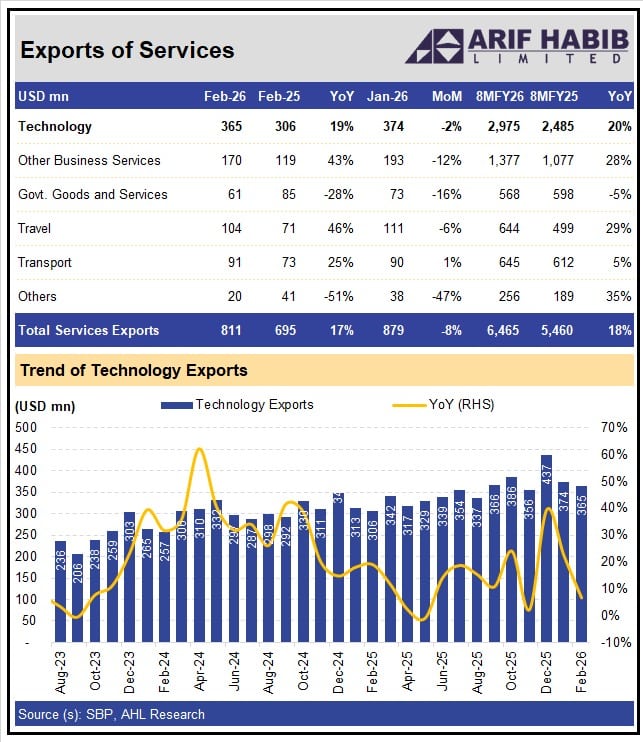
Pakistan’s IT and IT-enabled services sector recorded $2.97 billion in export inflows during July to February FY2026, marking a 19.6% year-on-year increase. However, a steady drop in monthly receipts over the past two months has tempered expectations around the government’s $5 billion annual target.
IT Exports Hit $2.97 Billion in July to February FY2026
According to data from the State Bank of Pakistan (SBP), Pakistan’s ICT export earnings grew by 19.78% year-on-year, reaching $2.61 billion in the first seven months of the current fiscal year ending June 2026, up from $2.18 billion during the same period last year. Cumulative inflows reached $2.97 billion by the end of February 2026, compared with $2.48 billion in the same period of FY2025.
IT exports now account for over 10.8% of Pakistan’s total exports. This is considered a historic milestone, reflecting the country’s gradual economic shift from traditional goods like textiles and rice toward high-value digital services.
Monthly Receipts Show a Two-Month Decline
Despite the cumulative growth, monthly figures reveal a softening trend. The sector peaked at $437 million in December 2025, before declining to $374 million in January 2026 and $365 million in February 2026, a drop of over 16% in just two months.
Analysts project exports to grow 18 to 20% in FY2026, which could bring the total to around $4.5 billion. This figure still falls short of the ambitious $5 billion target set under the government’s national economic plan, Uraan Pakistan. At the current monthly run rate of approximately $365 million, full-year IT exports are likely to plateau around $4.4 to $4.5 billion.
Geopolitical and Regional Pressures Add Uncertainty
The slowdown in monthly inflows is partly attributed to broader global uncertainty. Ongoing regional tensions have prompted clients, particularly across the US and GCC markets, to delay digital transformation and expansion projects. This has reduced near-term order flow for Pakistani IT firms.
The growing tendency of international companies to outsource software development, cybersecurity, and digital transformation projects has boosted Pakistan’s profile as an affordable IT services provider. Even so, regional instability continues to introduce uncertainty into forward planning for many of these engagements.
Beyond export figures, Pakistan’s broader startup ecosystem reflects a market in a phase of cautious maturation, with genuine momentum tempered by structural funding constraints.
Ecosystem Value Surpasses $4 Billion
Pakistan’s venture capital-backed startups have surpassed a combined enterprise value of $4 billion, up 3.6 times since 2020, according to the January 2026 Pakistan Tech Report by Dealroom.co and inDrive. The growth rate outpaces larger ecosystems including India, New York, Paris, and Dubai, placing Pakistan among emerging “New Frontier” tech markets.
The country now hosts over 170 VC-backed startups, with roughly 17 “breakouts” that have raised between $15 million and $100 million, two scale-ups that have crossed $100 million in funding, and 13 “Colts” generating between $25 million and $100 million in annual revenue.
According to TechList Pakistan, which tracks startup funding activity across the country, deal flow in early-stage rounds, particularly pre-seed and seed, has remained consistent through Q1 2026. Fintech, healthtech, and B2B SaaS have emerged as the three most active verticals during this period.
Startup Funding Rebounds in 2025
Pakistani startups secured over $74.23 million in equity and hybrid financing in 2025, spanning pre-seed, seed, and Series A rounds across fintech, mobility, healthtech, and other sectors. According to Data Darbar, local startups raised about $36.6 million in equity across 10 disclosed rounds, a modest increase from $22.5 million the previous year, though deal volume slipped slightly from 15 to 14 transactions.
Fintech and Healthtech Lead Investment Activity
The fintech sector continues to dominate investment activity, with startups such as Haball and Metric securing sizeable Pre-Series A and seed funding rounds. Analysts say fintech’s appeal lies in its ability to integrate with banking infrastructure, simplify payments, and tap into an underserved market of SMEs and digital consumers.
Haball secured a $52 million Pre-Series A funding round led by Zayn VC and backed by Meezan Bank. The company has scaled its platform to handle over $3 billion in payments, disbursing more than $110 million in financing while supporting thousands of SMEs and multinational clients.
Healthtech is emerging as the second major growth engine. MedIQ’s $6 million Series A and Xylexa’s $1 million seed round highlight strong investor appetite for solutions that address healthcare accessibility, a critical need in a country of over 240 million people.

No Unicorns Yet: The Capital Gap Remains
Despite the momentum, no Pakistani startup has yet reached unicorn status or surpassed $100 million in annual revenue. Limited domestic capital is widely identified as the primary bottleneck holding the ecosystem back from the next level of scale.
Globally, venture capital investment reached $512.6 billion in 2025, up 30.8% from 2024, with artificial intelligence alone accounting for $270.2 billion. For Pakistan, these global trends highlight the structural challenge of competing in capital-intensive sectors like AI without matching infrastructure or investment scale.
Female-Founded Startups Gain Ground
One of 2025’s notable trends is the rise of female-led startups, which raised $8.8 million in disclosed equity, accounting for more than 24% of total funding. Startups including Shadiyana, BusCaro, Metric, MedIQ, and Lean Outset were among the female-founded or co-founded ventures contributing to this shift. TechList Pakistan has closely documented this trend through its founder coverage and funding trackers.
Policy Reforms Supporting Export Growth
The State Bank of Pakistan raised the permissible retention limit in Exporters’ Specialised Foreign Currency Accounts (ESFCA) from 35% to 50%. This allows IT exporters to retain a larger share of their dollar earnings, a reform that has provided greater liquidity for companies reinvesting in global operations.
Pakistan’s 5G spectrum auction, conducted in March 2026, is expected to unlock new product categories in healthtech, edtech, IoT, and industrial automation that have remained structurally inaccessible on existing infrastructure. Building quality talent, empowering grassroots entrepreneurship, and accelerating local AI adoption are identified as the three pillars needed to position Pakistan as a competitive global IT export hub.
Long-Term Target: $10 Billion by 2029
National long-term targets foresee $10 billion in annual IT exports by 2029, a goal that requires a significant acceleration from the current growth trajectory. IT exports now constitute over 40% of Pakistan’s total services exports, supporting foreign exchange stability, high-value employment, and entrepreneurship. This cements the sector as a core pillar of Pakistan’s broader economic strategy.
Closing the gap between the current pace and the $5 billion FY2026 target will require reversing the recent monthly decline, broadening client geographies beyond the US and Gulf, and continuing to scale startups into globally competitive businesses. The structural groundwork is being laid, but sustained execution remains the sector’s defining test going forward.
Sources: State Bank of Pakistan (SBP), Ministry of Information Technology and Telecommunication, Data Darbar, Dealroom.co / inDrive Pakistan Tech Report (January 2026), Topline Research, Pakistan Software Houses Association (P@SHA), TechList Pakistan.